From Masters’ Hands: Catawba Indian Pottery
June 27 - December 16, 2026
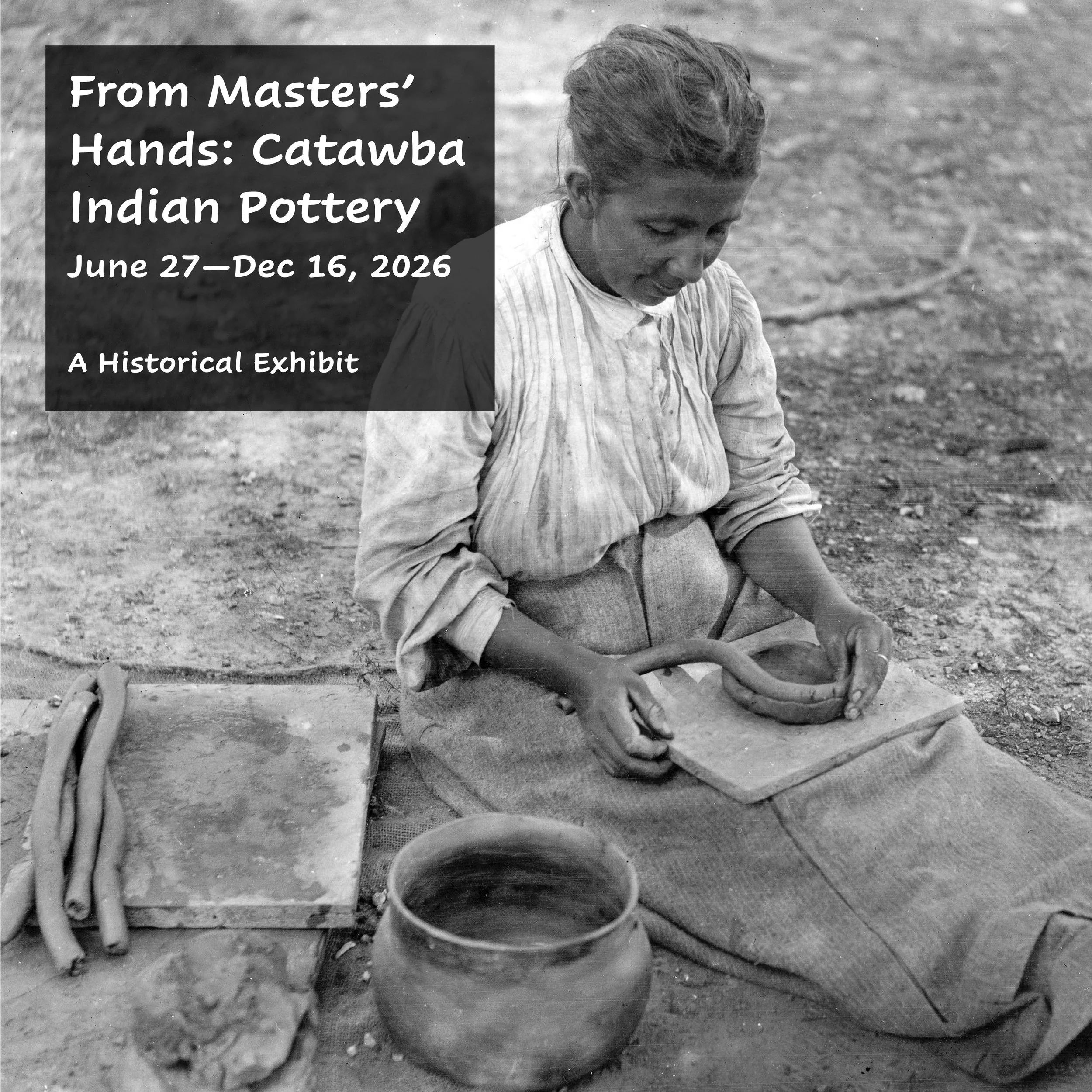
Understandably, some may be sensitive to the term “Indian.” It is used here intentionally, as it is the term the Catawba people themselves have historically used to describe their identity and their craft traditions since European colonization.
You may hear Catawba Indian potters refer to “the old Indians.” They are potters whose names have been lost to time. The goal of this exhibit is to show work from the hands of master potters who were one, two, or at most three generations removed from “the old Indians.” The influence of those earlier makers ensured the production of pottery that followed the older styles.
It is reasonable to assume that a potter with a birth year ca. 1840 or earlier had the opportunity to learn directly from, or at least see the work of, “the old Indians.” There is scant information about Catawba potters before 1800. Most of the Catawba Indian pottery produced up until the late 1870s was utilitarian: cooking pots, water jars, food containers, milk pans, and pipes. As the 1880s approached, the work of the Catawba potters began to draw the attention of scholars and anthropologists.
In 1879, Congress established the Bureau of Ethnology. This became the Bureau of American Ethnology of the Smithsonian Institution. Anthropologists were dispatched to preserve what remained of Indian culture in the Southeast. Several of them visited the Catawba and Cherokee. Even earlier, a “naturalist,” Francis Simmons Holmes, curator of the College of Charleston Museum, which opened in 1852, must have had some interest in the Catawba people, as two pieces of Catawba Indian pottery in the Smithsonian were donated by him in 1875.
As time passed, capitalizing on the tourist trade became more lucrative than utilitarian pottery. As a result, Catawba Indian pottery began to change and adapt to tourists' preferences.
Guest curated by Mac and Rebecca McAtee